~30,000 tonnes
Of used EV batteries entering the Australian waste stream. For context, B-cycle has recovered 11,000 tonnes across all battery types combined since 2022. EV traction packs are a different order of scale.

Four possible futures for a retired pack — manufacturer takeback, insurance write-off, private salvage, and second life. Who pays at each step, where the chain breaks, and what to do if you’re the one holding the battery.
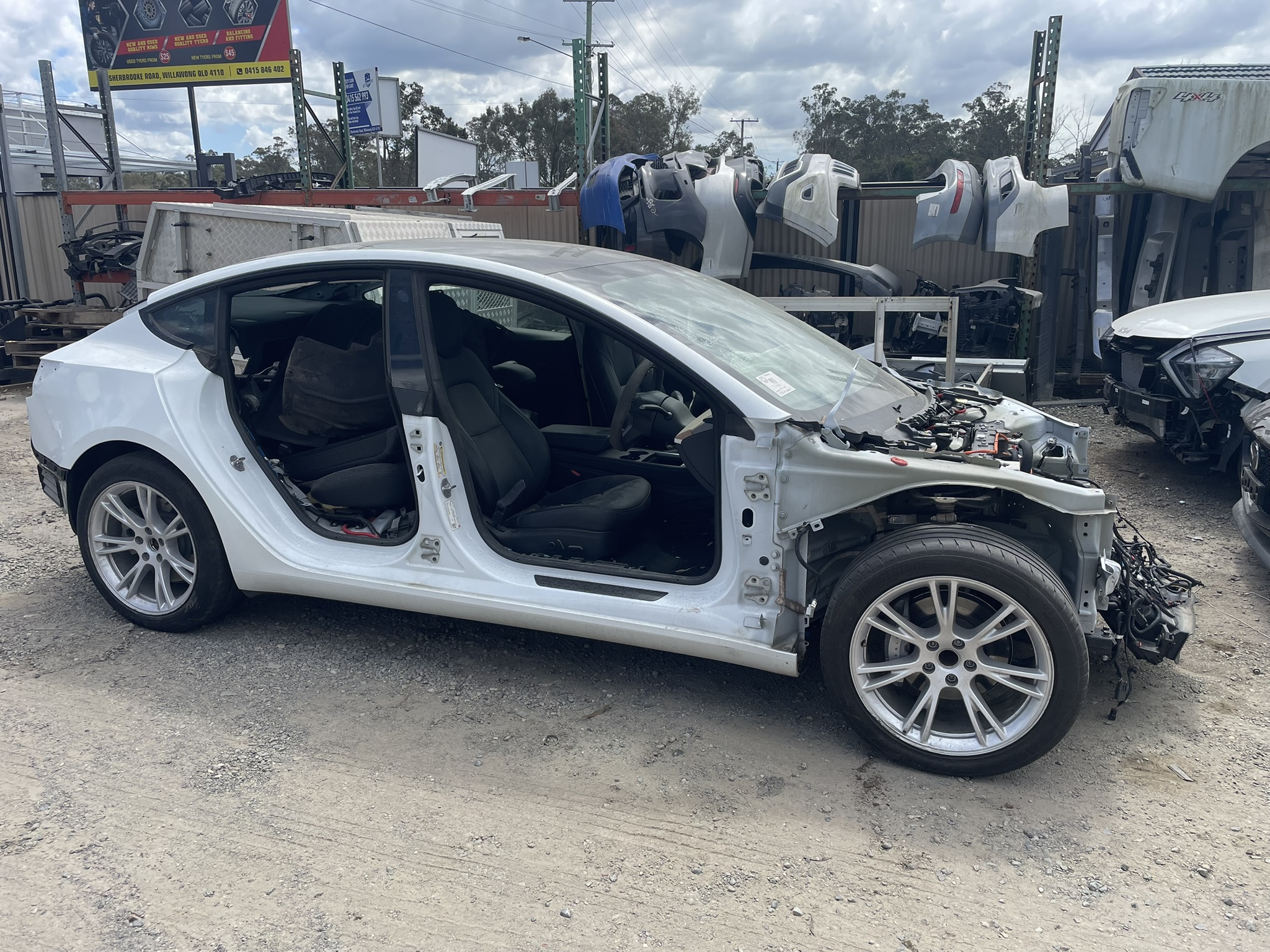
An EV reaches end of road life. The car is written off, parted out, retired from a fleet. What happens next to the 500-kilogram lithium pack underneath? In Australia, that question doesn’t have a single answer. It has four — and the difference between them is determined almost entirely by economics.
Some batteries flow neatly through manufacturer takeback agreements to a certified recycler. Others end up stockpiled in regional yards because nobody in the chain can afford to deal with them properly. The difference between the two outcomes is determined less by regulation than by economics — by who’s holding the cheque book at each step.
This article walks through the four pathways an out-of-car EV battery can take in Australia, who pays at each stage, what happens when the chain breaks, and the legal framework around it all.
When manufacturers say a battery has “reached end of life,” they mean end of life in a car. A pack typically gets retired from automotive duty when its capacity drops to around 70–80 percent of original — at which point range loss becomes noticeable to the owner. The pack itself is still functional; it just no longer meets the demands of vehicle propulsion.
This single fact creates the four pathways below. A retired EV battery is not an obviously-spent product the way a flat AA battery is. Whether it gets shredded, repurposed, or stockpiled depends entirely on who ends up with it and what they decide to do.
Researchers at the University of Technology Sydney have modelled the wave. The wave hasn’t hit yet — but the infrastructure decisions made now are the ones operating when it does.
Of used EV batteries entering the Australian waste stream. For context, B-cycle has recovered 11,000 tonnes across all battery types combined since 2022. EV traction packs are a different order of scale.
Twelve times the 2030 figure. The first generation of EVs ages out; the second generation follows. The wave doesn’t crest — it keeps building.
Heavier than a small fleet of aircraft carriers, spread across Australian driveways, scrap yards and warehouses. Almost all of Australia’s current recycling capacity sits in two facilities in one suburb of Melbourne.
The sector already supports nearly 20,000 jobs and could reach $6.9 billion by 2050 — if the industry is built in time to meet the volumes projected for the 2030s and 2040s.
Here’s the question that actually matters: when an EV is written off in regional NSW, how does the battery get from the wreck to a recycling plant in Melbourne — and who’s paying for that?
The dominant pathway today. Almost every major EV brand has a direct commercial recycling agreement with a local processor. Under these deals, when a battery reaches end-of-life through a dealer, the dealer holds it in fire-isolated quarantine and arranges Class 9 dangerous-goods transport to the recycler. The OEM pays the processor a fee plus transport — because the recovered material value alone doesn’t yet cover the cost of safe handling. This is why current-generation EV batteries from major brands rarely end up in landfill: there’s a paying customer at every step.
Battery pack replacement starts around AU$20,000 and can be 50 percent of the car’s market value — which is why insurers routinely write off EVs after relatively minor accidents, and why EV insurance premiums sit roughly 50 percent higher than equivalent petrol cars. The wreck goes to a specialist salvage auction (Pickles or Manheim both run dedicated EV salvage streams), and the battery flows to a recycler. The insurer effectively pays via the write-off settlement. The cost lands back on EV-driving policyholders as higher premiums.
A private buyer purchases a write-off at auction, parts the car out, and is left holding the battery — with no commercial relationship with any recycler. Now the wrecker has to pay out of their own pocket: freight, dangerous-goods packaging, processing fees, all from a transaction whose margins are already thin. The honest path is to absorb the loss. The other path is to let the pack sit behind the shed indefinitely. This pathway is the structural risk for the wider system, and it will multiply as the car parc ages.
Companies like Relectrify, Infinitev, and ourselves at Better Life Batteries occupy a different position in the chain entirely. We don’t dispose of batteries — we acquire packs that still have useful capacity and rebuild them as stationary storage products. The repurposer pays the salvage operator, because a healthy second-life pack has positive residual value as a product, not negative residual value as waste. The battery gets a second decade of life rather than going to a shredder — and every repurposed pack is one less Class 9 transport job downstream.
Australia’s experience with solar panel recycling over the last decade is instructive — and the parallels to EV batteries are uncomfortably direct.
Sustainability Victoria’s John Polhill said publicly in 2023: “At the moment, it would be cheaper to put them into landfill than to recover them.” Panel recycling ran $10–$30 per panel against landfill costs of a few dollars. That price gap is the entire economic incentive for fraud — and it produced exactly the failure modes the gap predicts.
Australia’s most prominent solar recycler collected fees from customers to recycle panels. By 2022 Reclaim PV had ceased trading. By mid-2023, an estimated 70,000+ panels were stockpiled at their SA and Brisbane sites. The company was wound up in September 2023. As far as public records show, no criminal prosecution or environmental fine was levied against the directors.
EV packs are large enough to be individually traceable. Manufacturers maintain direct commercial agreements with recyclers. And a healthy second-life pack has positive residual value — high enough to incentivise repurposing rather than disposal. Those advantages buy the system time. They don’t make it immune to the same failures.
The law on battery disposal in Australia is not nationally consistent. There is no Australian state where dumping an EV battery in landfill is prudent — but geography determines whether you face a specific battery-related fine or a general waste-disposal penalty.
The honest summary: there’s no state where disposal is risk-free, and in most states it’s actively illegal. The question is what kind of illegal it is.
A damaged lithium-ion pack isn’t just a disposal problem — it’s an active safety hazard that can re-ignite weeks after the original incident.
Standard practice for a damaged EV pack is open-air, fire-isolated quarantine for monitoring — sometimes weeks. According to AFAC, the thermal incident hazard can persist for over four weeks after an EV fire is “extinguished.” NSW Transport and Fire & Rescue NSW operate a specialised submersion trailer for transporting damaged packs from crash sites.
Road and rail transport of damaged or defective lithium batteries falls under the Australian Dangerous Goods Code, Special Provision 376. Packs must be transported under UN3480 or UN3481, packaged to Packing Instruction P908 or LP904. Class 9 dangerous-goods placarding required. Air transport of damaged lithium batteries is completely prohibited.
At a licensed processor — today that almost always means EcoBatt or Envirostream at Campbellfield, Melbourne — the pack is deliberately discharged (often by submersion in salt water) and shredded inside a water bath to suppress any remaining ignition risk. This process is expensive. It’s exactly why repurposing a healthy battery before it reaches this state saves significant cost and carbon.
If you’re holding a damaged pack: visible deformation, hissing or popping, unusual smells, or a pack that won’t communicate over its BMS — stop. Don’t try to move it yourself, don’t try to repurpose it, and don’t store it indoors. Contact a Class 9 dangerous-goods transporter or a specialist EV-recovery operator. The cost of doing this properly is much lower than the cost of getting it wrong.
If you’re driving an EV still under warranty, you don’t need to think about most of this. The manufacturer owns the problem — and has a commercial relationship with a recycler to prove it.
If you’re driving an out-of-warranty EV, buying a write-off, or sitting on a salvaged pack from a job site — the situation is different. You’re holding tens of kilograms of lithium and an active compliance question. The right path depends on the pack’s condition:
The good news is that Australia’s repurposing and recycling industry is finally scaling up. By 2050 the sector could be worth $6.9 billion. There’s a real economy here — not just a waste problem waiting to explode.
Most current-generation EV batteries from major brands flow neatly to recyclers. The cracks open at the edges — private salvage, regional dismantlers, and batteries separated from their commercial chain. That’s where the solar panel cautionary tale has the most to teach us.
OEM takeback and insurance write-off pathways have paying customers at every step. These work. The risk is what happens as the car parc ages and batteries move further from their original commercial chain.
Informal salvage is where batteries genuinely fall through the cracks. No OEM relationship, no insurer footing the bill. The wrecker has to pay — and when margins are thin, the shed wins. This will get worse before it gets better.
Every healthy pack that gets a second decade as stationary storage is one less Class 9 transport job, one less shredding run, and one less tonne in the projected 2050 wave. Cornell University research: reusing before recycling cuts lifetime carbon footprint by up to 17 percent.
 Sam · Mt Crosby workshop
Sam is a chartered and registered electrical engineer with over 15 years’ experience delivering electrical assets for Queensland. Better Life Batteries sources, assesses and repurposes second-life EV packs for serious Queensland applications.
Sources: Battery Stewardship Council (B-cycle); DCCEEW; UTS battery waste projections; NSW EPA — Product Lifecycle Responsibility Regulation 2026; ARENA Relectrify Lessons Learnt Report (2024); Australian Dangerous Goods Code Edition 7.5 (Special Provisions 376, 377); AFAC EV Emergency Response policy; Livium / Envirostream and EcoBatt company disclosures; Infinitev Australia; CHOICE EV insurance premium data (January 2026); Pickles and Manheim salvage auction listings; SA EPA, EPA Victoria, WA DWER, NSW EPA published landfill regulations; Sustainability Victoria; SolarQuotes; pv magazine Australia reporting on Reclaim PV wind-up (September 2023); Federal parliamentary inquiry into solar stewardship submissions.
We assess packs individually — state of health, cell spread, cycle count. If there’s good life in it, we’ll pay for it and build a system around it. If not, we’ll point you to the right recycler.